About
A supply business run by someone who has spent 14 years at the instrument
Dr. Nazmul Alam, Greater Toronto Area, Ontario
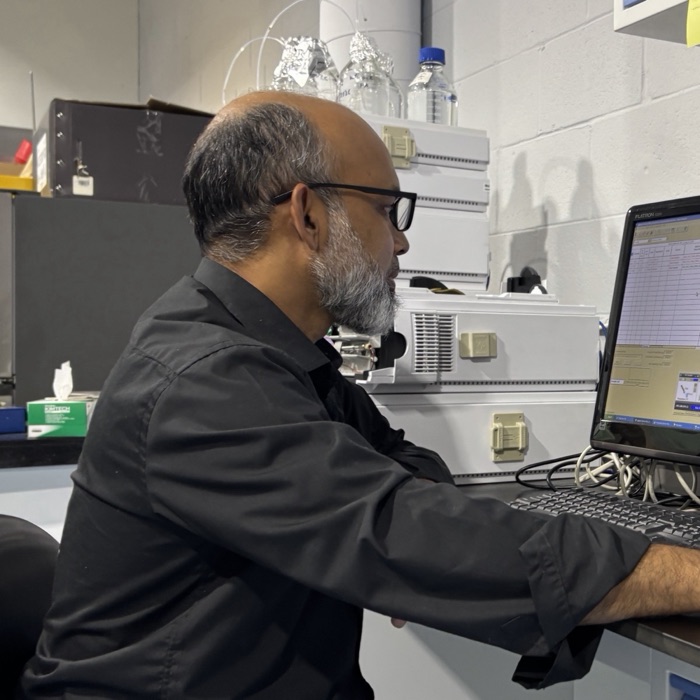
I am Dr. Nazmul Alam. My PhD is in separation science, from the University of Waterloo in Professor Janusz Pawliszyn's group, on quantitation in solid-phase microextraction: extraction kinetics, mass transfer and numerical modelling of how compounds partition between phases. After that I spent 14 years running methods for a living: bioanalytical LC-MS/MS at contract research organisations, high-resolution MS at the Ontario Ministry of the Environment, natural health product QC, and method development in a cGMP environment.
That background is why this site covers preparative work as well as analytical. Choosing a flash cartridge and choosing an HPLC column are the same problem in different clothes. Which stationary phase holds your compound, how much you can load before the band spreads, and what solvent strength moves it without losing the separation. The hardware changes. The physics does not.
It is also why sample preparation is here. My thesis was on quantitation in solid-phase microextraction, and most of my published work is on how fast a compound moves from a sample into a sorbent, and what decides how much of it gets there. That is the same question a lab is asking when the recovery is 60% and nobody can say where the other 40% went. Extraction is where methods lose material, and it is usually the last stage anyone checks.
Chromkit exists because of a pattern I kept seeing. Labs order consumables from a part number somebody copied off the last order, and instruments from whichever quote came back first. Then they spend two days chasing a problem the purchase created.
I once lost 2 days to a fronting peak. I swapped the column. Same peak. I re-prepped every sample. Same peak. The column was fine. My injection solvent was stronger than my mobile phase. Nothing I could have bought would have fixed that, and a distributor would have sold me another column.
So the order here comes second. Tell me the analyte and the matrix, and the first thing you get back is what you should be running. The quote follows that.
How Chromkit makes money
Two ways, and they work differently, so it is worth being clear about which one you are dealing with.
Consumables I buy and resell. I am the vendor of record. I buy the part, import it, and invoice you in Canadian dollars with HST. My margin is the difference between what I pay and what I quote you, and it is in the price rather than added on top. You set me up once as a supplier and after that you can order anything I source, which is the part procurement usually cares about.
Instruments I sell and support. New and refurbished instruments are sold the same way as consumables: Chromkit invoices you, so your contract and your warranty are with me. Refurbished systems are held in stock in the Greater Toronto Area and shipped worldwide, serviced and performance-checked before they are listed, and the configuration, software licence and warranty are stated in the quote. Installation, service contracts and parts are available for them too, so you are not left looking for someone to keep the instrument running.
Either way, if the honest answer is that your current column is fine, or that the used system you are looking at is the wrong instrument category for your analyte, that is the answer you will get. The whole thing depends on you trusting the recommendation, so it is stated here rather than buried.
Method work and training
Method development, troubleshooting and hands-on HPLC and LC-MS training are separate, and they live at nalam.ca. Keeping them apart is deliberate. Advice you pay for should not be shaped by what somebody wants to sell you.